

Faster Internet is in the air.
Now you can get blazing fast high-speed Internet performance all over town. WiMAX-enabledΔ Intel® processor-based devices deliver Internet speeds three times faster than 3G, making your mobile computing experience as “plugged-in” as it would be if you actually were plugged in.
Look for laptops and Internet devices with optional WiMAX built-in to give you a head start.Δ
About WiMAX
WiMAX is the next evolution in wireless broadband, offering the best available mobile Internet experience with service covering entire metropolitan areas. It frees you from having to stay within a Wi-Fi area to be connected, thus turning your city into one big hotspot that delivers strong, fast Internet performance. As service becomes widely available, you'll wonder how you ever lived without WiMAX.
Wi-Fi and WiMAX—enjoy the best of both worlds with an Intel-powered device.
Get ready for the future today with a laptop or Internet device that offers both outstanding Wi-Fi connectivity and optional built-in WiMAX so you'll be prepared when city-wide broadband rolls out in your area. With both Wi-Fi and WiMAX capabilities, an Intel® Centrino® 2 processor technology-based laptop can be the ultimate in mobile computing for today's nomadic lifestyle. Or opt for a netbook or mobile Internet device powered by the Intel® Atom™ processor with WiMAX for high-speed Internet and powerful processing in a compact, portable form.
No wires. No worries. It’s WiMAX.
If you're someone who likes to use your laptop on the go, WiMAX offers a lot to get excited about. Need to jump online to check your bank balance, compare product reviews or send an email while you're out and about? When service is available in your location, you’ll feel confident knowing your WiMAX-enabled laptop or mobile device can stay online and productive all over town, even where no Wi-Fi signals reach.
Interact with friends, stream videos quickly, and download or upload large files in a flash—all without long wait times. With WiMAX, you can stop worrying about where you’ll connect from and start getting excited about what you’ll connect to.

You want rich, vibrant color and smooth, crisp images. You want to play high-definition content at full resolution, and you want cool realism when you play games. Thanks to Intel® Graphics Technology, that's not a problem. Whether you're shopping for a new laptop or a desktop PC, make sure your PC includes Intel Graphics Technology.
When you get a PC with Intel® Graphics Technology, you get an integrated solution that provides great performance. When selected as an option, Intel Graphics Technology comes built right into the PC, delivering excellent speed and functionality for beautiful playback of high-definition video and a great gaming experience.
How is integrated different? External video cards can consume more power, may require fans and make it more challenging to offer systems in a compact form factor, like an ultra-mobile laptop. Since it’s an internal, integrated solution, Intel Graphics Technology can enable a smaller, quieter PC that, in turn, can also deliver longer battery life for laptops and reduced power for desktops.
High-definition video has revolutionized entertainment, and Intel is making sure you get the full experience on your PC. With Intel® Clear Video Technology, a suite of video enhancements built into Intel Graphics Technology,λ video playback is nothing less than stunning.
Intel Clear Video Technology delivers enhanced video playback, sharper images, precise color and advanced support for the latest HD displays.
That experience isn’t limited to your PC monitor either. Intel Clear Video Technology makes it easy to watch video on the latest high-end TVs and displays in true digital too. Whereas typical audio and video connections require many cables, Intel Clear Video Technology achieves high-quality digital connections in a single cable, so it’s a snap to connect set-top boxes, DVD players and TVs.
Look for Intel Graphics Technology in your next PC, and you’ll be feasting your eyes on an amazing video-watching experience.

Making movies more magical than ever
Intel’s revolutionary 3D technology enables the artists at DreamWorks Animation* to entertain moviegoers like never before by fully immersing them into the story. InTru™ 3D is the mark letting movie-goers know they can expect the movie experience of their lives in amazing state-of-the-art 3D. Experience it for yourself at a theater near you in March 2009 with "Monsters vs. Aliens" by DreamWorks Animation.When Intel goes to the movies
In the words of DreamWorks Animation’s Chief Executive Officer, Jeffrey Katzenberg, InTru™ 3D allows animated films to become “an immersive experience, not an observational experience.” From the front row to the last, viewers now have a seat in the middle of the action. That’s why DreamWorks Animation has committed to producing all of its feature films using InTru™ 3D technology beginning in 2009.
In addition to working with DreamWorks Animation to enhance the in-theater experience, Intel is also developing next-generation 3D viewing experiences and technology for a range of other platforms, including home theater, personal computers, video games, and online environments.


For Desktops
Meet the newest member of the Intel® Core™ family
Get a major boost in PC power for fast multitasking at work or at play with the Intel® Core™ i5 processor for desktops. With intelligent performance that accelerates in response to demanding tasks◊, such as playing games and editing photos, the new Intel® Core™ i5 processor moves faster when you doKey Features
A new level of intelligent performance
Maximize speed for demanding applications with Intel® Turbo Boost Technology◊, which accelerates processor clock speed up to 20%Δ to match your workload. So you’ll move faster when multitasking and get more accomplished in less time.
Do more at once
With the Intel® Core™ i5 processor, you can multitask up to 28% faster, so you can do more things at once‡1 and be more productive than ever.
Speedy content creation
Unleash an amazing digital media experience with up to 37% faster conversion of video for web upload‡2, up to 15% faster photo editing‡3 and up to 17 % faster conversion of CD music tracks to MP3‡4.
Get your game on
Get a 32% improvement in artificial intelligence for game characters and realistic physics for game worlds.‡5

About Ultra-Thin Laptops
Why wait? Step into the future with an ultra-thin laptop.
Sleek new ultra-thin laptops powered by the latest ultra-low voltage Intel® Core™ processors let you travel light and provide the performance you need for music, video, photos, and more. And thanks to optimized energy-efficient technology, they also enable longer battery life. Fast, sleek, smart—make sure your new ultra-thin laptop has Intel Inside®.New ultra-thin design. Intel® performance.
When you choose to go ultra-thin, you can feel confident that you’re getting the performance you need. That’s because the best-performing ultra-thin laptops have Intel Inside®, giving you the best of both form and function.Energy-efficient technology extends battery life in ultra-thin laptops
Intel® ultra-low voltage processors are optimized for battery life,‡2 so you can stay unplugged longer and use your laptop on the go without having to search for power outlets.Intel® technology helps enable the thinnest laptops
Ultra-thin laptops are the perfect balance of performance and style for mobile computing. Typically measuring less than 1.0 inches thin and weighing about one to two pounds less than standard laptops, ultra-thin laptops are effortless to carry on the go while still delivering the performance you need
THE EUROPEAN COMMISSION has released the details of Intel's appeal in its ongoing anti-trust case.
Intel contends in the filing (PDF) that the original decision is flawed and lacks sufficient evidence. Among Intel's arguments are claims that the European Commission failed to prove an actual attempt by Intel to drive rival AMD from the market by offering discounts to vendors.
"The Commission fails to meet the required standard of proof in its analysis of the evidence," Intel argued.
"Thus, the Commission fails to prove that Intel's rebate arrangements were conditional upon its customers purchasing all or almost all of their x86 CPU requirements from Intel."
The appeal is the latest in the anti-trust battle between Intel and AMD, which has issued complaints around the globe accusing Intel of coercing customers into abandoning AMD systems and moving exclusively to machines powered by Intel chips.
The decision from the European Union was the first high-profile judgement made against Intel in the battle. The Commission declared that the company had violated European anti-trust standards and levied a £948m penalty against the company.
Since the decision was released in May, Intel has maintained that it will appeal against the ruling. The company has repeatedly contended that EU investigators did not fully analyse the evidence, and that the Commission did not possess an accurate picture of the state of the semiconductor market.
Man, we like how Intel parties. Rather than standing around in front of all manners of junk food just waiting for presents, the aforementioned chip maker has decided it best to give us -- the loyal consumers of the world -- a gift on Atom's 1 year birthday. Over at the Intel Developer Forum in Beijing, the company is joyously celebrating the first anniversary of the world-changing Atom CPU. Just think -- prior to the Atom, we were forced to deal with notebooks that could barely last two hours and didn't have a shot at fitting in our back pockets.
During the past 12 months of MID, UMPC and netbook dominance, Intel has figured it prudent to keep things fresh despite the fact that no real competition has surfaced. Anand Chandrasekher, Intel senior vice president and general manager of the Ultra Mobility Group, held a keynote titled 'Mobility's Next Wave of Growth,' where he proudly presented the first live demonstration of the company's next-generation Atom-based MID platform, codenamed "Moorestown." We're told that this platform showcases a greater than 10x idle power reduction compared to today's Atom-based platform in a side-by-side demo, which is largely made possible by a combination of new power management techniques, a new partition optimized for the MID segments and Intel's Hi-k 45nm manufacturing process.
Moorestown is still slated to land in 2010 and will be comprised of a System on Chip (codenamed "Lincroft") that integrates a 45nm Intel Atom processor core, graphics, video and memory controller, and a companion input/output (I/O) hub (codenamed "Langwell"). Furthermore, it will be accompanied by a new Moblin software version that is optimized to enable the rich, interactive, PC-like Internet experience along with cellular voice capabilities.
On top of all that, Intel also took the wraps off of not one, but two new Atom CPUs. Granted, both of these are designed for MIDs and other embedded applications, but we're all about improving the ultra-ultraportable computing market -- which, honestly, has been seriously deprived of attention here lately. The first new guy is the Z550, which takes the clock speed to 2GHz and features Intel's Hyperthreading technology in a sub-3-watt power envelope. The next one (Z515) brings together Intel's Burst Performance Technology (Intel BPT), which enables it to hum along at 1.2GHz. No mention was made of exact release dates, but we're hoping that this progress means that N280 / Atom 330 successors are just around the bend. Pretty please, Intel?

 This is latest 17 Xeon processors are showing best conceptual future from another processor and this processor is very unique and providing best new technology. And this Intel today announced 17 new Intel Xeon processors based on Intel Core micro-architecture, codenamed Nehalem before. The processors are designed for use in servers, workstations and embedded segment planned. Main features of the processors are the automatic adaptability of the energy according to the requirement of the particular application and the speed with the highest performance levels for challenging transactions in the computing and large database queries. In addition, Intel presented today with the Intel 82599 10 Gigabit Ethernet Controller a new network chip. The new chips are the biggest advancement in the field of server CPUs, Intel has been 14 years ago with the Intel Pentium ® Pro in this market segment is entered. Intel expects that by 2015 more than 15 billion devices connected to the Internet will be and provide the necessary infrastructure to ensure that the new Xeon processors with their adaptability, efficiency and versatility also make a significant contribution. The most intelligent energy management contributes significantly to operating costs at a minimum: after about eight months, the cost of the Xeon 5500er processor paid off.
Your product is backed by either the manufacturer's warranty or the warranty provided by our other quality suppliers. Open Box items are excluded from manufacturer warranty. To request more information on a product warranty prior to purchase you can check via the manufacturer's website if the product is backed by a manufacturer's warranty or contact us at: warranties@eCOST.com or call 877-888-COST (2678). Please include the eCOST.com part number: 37140576 WARNING: Products with exposed solder may contain lead, a chemical known to the State of California to cause birth defects and other reproductive harm. Please wash hands after handling internal components and circuit boards and avoid inhalation of fumes if heating the solder. ed to bring a balanced level of proven technology and value to basic PC desktops. With the Celeron processor you can expect an affordable and reliable PC for your home or home office to meet your basic computing needs, such as e-mailing friends and relatives, tracking home finances, and running interactive or educational software for your kids. It provides great balance between computing power and affordability. The entire family of Celeron processors delivers Intel technology, quality, and reliability to the desktop, value PC consumer.
Manufacturer Information Parts Warranty 3 Years Labor Warranty 3 Years
The Intel Atom is a small, inexpensive, energy-efficient microprocessor that is found in the majority of netbooks shipping today. Designed by Intel Corp. from the grounds-up and to be introduced into a wider range of computing environments, Atom and its derivatives will power many of the low-power computers to be sold in 2009, and beyond. This HEXUS.help guide explains what Atom is, and how it’s changing the market. Recent microprocessor architectures from the two main x86 players, Intel and AMD, have focussed on using one basic design for the server, client, and mobile sectors. For example, the incumbent Intel Penryn architecture can be found in the enterprise space under the Xeon brand, in the client area under Core 2 Duo/Quad, and in the mobile sector under the Mobile Core 2 Duo/Quad branding. Derivating from one core architecture simplifies engineering and manufacturing but means that there is relatively limited scope for designing really low-power chips, because only so many parts of the chips, which draws some 125W in server form, can be switched off before its performance irrevocably stalls. This is why the Current Mobile Core 2 range has a TDP – which can be thought of as maximum power-draw – of 5.5W. However, most present mobile chips found in the vast majority of mid-range laptops have a TDP of 25/35W – leading to laptops consuming between 40W and 50W when under load. This kind of power-draw is not conducive for day-long battery life in a small, thin notebook. In effect, as of 2008, both Intel and AMD’s mobile chips clearly weren’t designed to be both power-frugal and cheap to produce. A new architecture was required if either company wanted to exploit a marketing opportunity for thin, light, and inexpensive notebooks. In that sense, Intel’s Atom can be thought of as the harbinger of the present netbook. Intel’s Atom series of processors, released in early 2008, have been specifically designed for low-power usage, but that’s manifested with performance that’s considerably slower than even the most-basic Mobile Core 2 chip, so how does it work? Atom is based on a 45nm manufacturing process and features an in-order execution architecture, which can be slower at computing than the out-of-order execution used by Intel and AMD’s better-performing chips. The Atom range is vast, encompassing single- and dual-core models, available with and without the performance benefits of HyperThreading. All Atom chips run Intel Architecture (IA-32) code, although only a handful have been enabled for 64-bit operation. Clock-speeds range from 800MHz to 1,600MHz and, crucially, TDP values range from just 0.65W to 8W. Putting the performance into context, the popular 1.6GHz-clocked Atom N270, found in a number of netbooks, returns a CINEBENCH R10 score of around 820 marks. A mid-range Mobile Core 2 Duo P8400 benchmarks at around 4,700 marks – almost six times higher! Given that performance is generally analogous to mobile chips from 2005, which is just good enough for a basic Internet experience, one of the main associated benefits of Atom is how relatively cheap it is to produce. The aforementioned Intel Atom N270 has a total of 47m transistors, based on a die-size of 25mm². Compare this with the 82mm² for the Mobile Core 2 Duo P8400 and it’s clear that a far greater number can be manufactured on a standard 300mm wafer – some 2,500, in fact, and 11x greater than Mobile Core 2 Duos. As we mentioned earlier, Atom is an umbrella term to cover these low-power, inexpensive-to-produce chips. The range is currently segregated into Atoms designed for the desktop and netbooks – codenamed Diamondville – and those for smaller mobile devices which require a lower power envelope – dubbed Silverthorne.The background
The architecture
The range
Welcome to the extreme performance platform brought to you by Intel® Desktop Board DP45SG, supporting the Intel® Core™2 Extreme processor with up to 1333 FSB. Built in the full size ATX, this board comes with dual PCI Express* (PCIe) 2.0 x16 graphics connectors, DDR-3 1333 support and overclocking capabilities. Intel® Desktop Board DP45SG will take your gaming experience to a higher level. Intel Desktop Board DP45SG supports Dolby Home Theater* and is Microsoft Windows Vista* Premium WHQL certified.
The ground-breaking Intel® Dual Socket Extreme Desktop Platform is the first dual socket desktop board from Intel, the world leader in silicon innovation. With dual CPU capability that provides up to 8 core processing, the Intel® Desktop Board D5400XS delivers unmatched performance for advanced digital media creation and editing. The platform also delivers heart-pounding performance for multi-core enabled game titles, particularly in a multi-tasking environment where simultaneous applications need maximum processing power.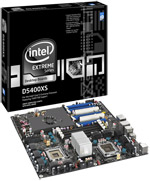

Intel Desktop Board DX48BT2 supports Dolby Home Theater* and Microsoft Windows Vista* Premium WHQL certified.
Launch clock speeds and other details aren't available, although Clarkdale should inherit Nehalem's Hyperthreading technology and in some cases simulate a quad-core processor by assigning two instructions per core. Shrinking the chip assembly technology from 45nm to 32nm will allow either higher clock speeds without affecting power and heat or else can reduce those two at the same clock speed. Intel is reportedly interested enough in Clarkdale that it will account for 20 percent of all the company's processors and overtake most regular 45nm parts.
Why the processor line would move up isn't definite, although the change would hurt AMD, which has recently been regaining some of its lost market share and is lagging behind Intel in producing 32nm chips. Clarkdale would also permit smaller, more compact desktops without sacrificing speed.
Factoids
1 billion Internet-connected PCs
Intel estimates that there are approximately 1 billion Internet connected PCs worldwide today.
10,000 times as many transistors
The Intel® Core 2 Duo processor has 291 million transistors, more than 10,000 times as many transistors as the Intel 8088 CPU in the first IBM PC which had only 29,000 transistors.
The first IBM PC
The first IBM PC did not include a mouse, graphical user interface with Windows or icons, 3-D or animation capability or a hard drive to save files. The most common monochrome model cost approximately $3,000.
Today's PC
Today, consumers can buy a basic desktop PC with a workhorse Intel® Celeron® D processor, a 160 gigabyte (160 billion bytes) capacity hard drive, 256 megabytes (256 million bytes) of RAM, and a flat-panel monitor for less than $500 (U.S.). They can also buy a super high performance PC with an Intel® Core™2 Duo processor, 4 gigabytes of RAM , a 500 gigabyte hard drive, and deluxe graphics and sound systems for less than $2,300.
Twenty five years of PC evolution
The introduction of the IBM personal computer (PC) in 1981 marked a fundamental turning point in computing. Today it would be hard for many of us to imagine our lives without Personal Computers.
SANTA CLARA, Calif., Jan. 23, 2007 — Intel Corporation today introduced the Intel® Next-Gen Wireless-N network connection, an upgrade to the wireless component found inside Intel® Centrino® Duo mobile technology and other Intel-based laptops that helps consumers better connect to wireless networks.
As notebook PCs increasingly download broadband-intense content such as movies, videos and music, a more powerful networking solution is needed. Based on the draft 802.11n Wi-Fi specification, the Intel Next-Gen Wireless-N technology addresses that need by offering users up to five times** the performance and twice the wireless range – while providing up to an extra hour of notebook battery life when compared to existing Draft-N products.**
In addition, Intel said it has initiated the "Connect with Centrino" program. Through this program, Intel has worked with leading access point (AP) vendors including Asus, Belkin, Buffalo, D-Link and Netgear to better ensure compatibility and performance. Intel's wireless-N product is certified to work with multiple APs and as these AP's successfully pass Intel's rigorous real-world testing certification criteria, they will display a "Connect with Centrino" identifier on their product packaging, allowing consumers a choice for connecting with more confidence.
"Integrating wireless-N technology into notebook computers based on Centrino Duo with the Intel® Core™ 2 Duo processor delivers the speed, coverage and multi-tasking abilities needed for consumers to enjoy their home networking and digital entertainment," said Dave Hofer, director of wireless marketing for Intel's Mobile Platforms Group. "Additionally, access points that are identified by our new 'Connect with Centrino' logo assure consumers that they are purchasing a compatible wireless-N system."
The new wireless-N technology improves the home network experience – especially when multiple people access their wireless network simultaneously and enjoy bandwidth consuming applications such as audio and video entertainment. Intel's Next-Gen Wireless-N product reduces "dead spots" in the home; optimizes high-definition (HD) entertainment experiences such as streaming HD movies; improves battery life and provides the benefit of working with existing 802.11 a/b/g access points.
Intel Centrino Duo mobile technology-based laptops operate faster and more efficiently with Intel Next-Gen Wireless-N enhanced wireless communication capabilities. At the heart of the platform, the Intel Core 2 Duo processors have two processing cores – or computing "brains" – that can handle multiple tasks in less time while consuming less power. When integrated into Intel Centrino Duo-based systems running wireless-N, the Intel Core 2 Duo processors can improve viewing and playing back HD video, speed up conversion of songs into a digital format to upload to an MP3 player, and more quickly run the latest virus protection updates.
Intel Next-Gen Wireless-N technology as well as the "Connect with Centrino" identifier will be delivered in conjunction with new notebook computers powered by Intel Centrino Duo mobile technology from OEMs such as Acer, Asus, Gateway and Toshiba that are being distributed with Microsoft Windows Vista beginning in late January and other OEMs to follow.
Operating days and hours
Hours:
Monday – Friday, 9:00am – 6:00pm
Saturday 10:00am – 5:00pm
(Closed on USA holidays)
Intel Museum and Intel Museum Store closed:
July 3–4, 2009
September 7, 2009
November 25–26, 2009
December 25, 2009
Schedule a tour
Learn about tour options
Schedule your tour
Location & contact information
On the Web:
www.intel.com/museum
Museum address:
Robert Noyce Building
2200 Mission College Blvd
Santa Clara, CA 95054
Phone: 408-765-0503
For directions ›
General information
Admission and parking are free.
Bags and backpacks are not permitted in the Intel Museum or Intel Museum Store.
Coat check services are not available.
Photography is allowed in the Intel Museum.
Some of the participants in this market are simply seeking to exchange aforeign currency for their own, like multinational corporations which must pay wages and other expenses in different nations than they sell products in. However, a large part of the market is made up of currency traders, who speculate on movements in exchange rates, much like others would speculate on movements of stock prices. Currency traders try to take advantage of even small fluctuations in exchange rates. In the foreign exchange market there is little or no 'inside information'. Exchange rate fluctuations are usually caused by actual monetary flows as well as anticipations on global macroeconomic conditions. Significant news is released publicly so, at least in theory, everyone in the world receives the same news at the same time. Currencies are traded against one another. Each pair of currencies thus constitutes an individual product and is traditionally noted XXX/YYY, where YYY is the ISO 4217 international three-letter code of the currency into which the price of one unit of XXX currency is expressed. For instance, EUR/USD is the price of the euro expressed in US dollars, as in 1 euro = 1.2045 dollar. Unlike stocks and futures exchange, foreign exchange is indeed an interbank, over-the-counter (OTC) market which means there is no single universal exchange for specific currency pair. The foreign exchange market operates 24 hours per day throughout the week between individuals with forex brokers, brokers with banks, and banks with banks. If the European session is ended the Asian session or US session will start, so all world currencies can be continually in trade. Traders can react to news when it breaks, rather than waiting for the market to open, as is the case with most other markets. Average daily international foreign exchange trading volume was $1.9 trillion in April 2004 according to the BIS study. Like any market there is a bid/offer spread (difference between buying price and selling price). On major currency crosses, the difference between the price at which a market maker will sell ("ask", or "offer") to a wholesale customer and the price at which the same market-maker will buy ("bid") from the same wholesale customer is minimal, usually only 1 or 2 pips. In the EUR/USD price of 1.4238 a pip would be the '8' at the end. So the bid/ask quote of EUR/USD might be 1.4238/1.4239. This, of course, does not apply to retail customers. Most individual currency speculators will trade using a broker which will typically have a spread marked up to say 3-20 pips (so in our example 1.4237/1.4239 or 1.423/1.425). The broker will give their clients often huge amounts of margin, thereby facilitating clients spending more money on the bid/ask spread. The brokers are not regulated by the U.S. Securities and Exchange Commission (since they do not sell securities), so they are not bound by the same margin limits as stock brokerages. They do not typically charge margin interest, however since currency trades must be settled in 2 days, they will "resettle" open positions (again collecting the bid/ask spread). Individual currency speculators can work during the day and trade in the evenings, taking advantage of the market's 24 hours long trading day.FOREX - the foreign exchange market or currency market or Forex is the market where one currency is traded for another. It is one of the largest markets in the world.
Forex training is a must for anyone serious about turning a profit in the market

Forex training is a must for anyone serious about turning a profit in the market
Never mind how well you did in school or what sort of IQ you have, we all need specified educating in certain areas. The forex market is no exception to this. Forex training should be a requirement for anyone considering getting serious about trading world currencies for profit.come into forex details
Is formal training truly necessary? After all, there are plenty of books and online articles on the subject. Wouldn’t it be enough to read them on your own and moving into the market without following through the hassle of official training?
Well, consider it this way. You could read manuals on how to fly a plane, but you probably wouldn’t prefer to try it for real without getting some hands-on training first in a simulator. By the same token, you shouldn’t jump into buying and selling currencies without getting some training first. You might be able to manage successfully without it, but you’ll be so much better prepared with it.
Forex is a complicated, highly nuanced financial area, and the people who are experts in it are well aware that the average person recognizes almost nothing about it. To help share the wealth of information, the experts have formulated a number of training systems on the Internet and elsewhere.for more details about forex
Many forex training systems offer simulators or exercise accounts. In these, no real money is involved. It’s pure simulation, giving new traders an up-close-and-personal consider the market with no financial risk. In these demos, you get all the charts, estimates and other data you’d get if you were doing it for real. It’s excellent practice for the real thing.
Forex training is rarely free, however. Depending on the type and depth of training, it can be anywhere from $50 to several hundred dollars. How much training you need depends on how serious you are about linking up the marketplace. If you truly prefer to make money buying and selling currencies, it might be wise to get as much training as possible. On the other hand, if you intend to do it as a hobbyist, and if you limit your investments up front to adjust for the learning curve, you might do well enough with just the basic training.
Either way, you owe it to yourself to follow the training lessons carefully. Learn as much as you can from the resources available to you. It will help you turn a profit when you get into trading and help you minimize your financial losses.
Now let's take a look at this :Real Money Doubling Forex Robot,
the Only Automated Forex Income Solution That Doubles Real Monetary Deposits In Under 30 Days. No Backtest Tricks. The Best Converting And Best Performing Forex Product On The Planet, Period. No Wonder It Sells Like Candy. You can get as much training as possible here
It is worth noting that any place that previously used one or more of the currencies listed below has now also adopted the Euro. This applies to the Principality of Andorra, the Principality of Monaco, and the Republic of San Marino. This of course applies automatically to any territories, departments, possessions, or collectivities of Euro-zone countries, such as the Azores, Balearic Islands, the Canary Islands, Europa Island, French Guiana, Guadeloupe, Juan de Nova, the Madeira Islands, Martinique, Mayotte, Reunion, Saint-Martin, Saint Pierre and Miquelon, to name just a few. Euro bank notes and coins began circulating in the above countries on January 1, 2002. At that time, all transactions in those countries were valued in Euro, and the "old" notes and coins of these countries were gradually withdrawn from circulation. The precise dates that each "old" currency ceased being legal tender are noted in the table below. For convenience, and because their values are now irrevocably set against the Euro as listed above, the XE.com Universal Currency Converter will continue to support these units even after their withdrawal from circulation. In addition, most outgoing Euro currencies will still be physically convertible at special locations for a period of several years. For details, refer to the official Euro site as listed in the Relevant Links section below. A note about spelling and capitalization: the official spelling of the EUR currency unit in the English language is "euro", with a lower case "e". However, the overwhelmingly prevailing industry practise to spell it "Euro", with a capital "E". Since other currency names are capitalized in general use, doing so helps differentiate the noun "Euro", meaning EUR currency, from the more general adjective "euro", meaning anything even remotely having to do with Europe. This is particularly pervasive in marketing and advertising, where it is common to read statements like, "Try new Goop™ hair gel with genuine euro style and hold!" Nevertheless, this linguistic nuance is very subtle, even for native English speakers. it is also important to note that many languages have different official spellings of the name or EUR unit, which also may or may not coincide with general use. For more information on the EUR, we encourage you to visit the Websites listed below, particularly the official one. These sites include recent news on the Euro as well as issues like implementation, spelling, legislation, and many more.
On January 1, 1999, eleven of the countries in the European Economic and Monetary Union (EMU) decided to give up their own currencies and adopt the Euro (EUR) currency: Austria, Belgium, Finland, France, Germany, Ireland, Italy, Luxembourg, the Netherlands, Portugal, and Spain. The Vatican City also participated in that changeover. Greece followed suit on January 1, 2001, Slovenia on January 1 2007, Malta and Cyprus on January 1, 2008, and Slovakia on January 1, 2009.

* Offshore crude storage up sharply in last 2 weeks (Updates with settlement prices, replaces last graph on offshore storage) By Matthew Robinson NEW YORK, Aug 7 (Reuters) - Oil fell from six-week highs on Friday, pressured by gains in the dollar following the release of better-than-expected U.S. job-loss numbers. U.S. employers cut 247,000 jobs in July, far less than expected and the least in any month since last August, according to a government report, adding to optimism that the world's largest economy was turning around. [ID:nN07385157] "The jobs report was a mixed bag for crude traders. On the one hand, it was good for fundamentals for people to be working and able to buy things," said Chris Jarvis, senior analyst at Caprock Risk Management in Hampton Falls, New Hampshire. "But it could mean that Europe will be seen as the lagging market and get people to short the euro, and a stronger dollar longer term, and put some pressure on commodities." U.S. crude The drop came as the dollar gained against the euro and the yen, putting pressure on commodities denominated in the greenback. [.N] Wall Street gained following the release of the U.S. jobs data. The economic crisis has damped fuel demand, pushing crude from record highs near $150 a barrel in July 2008 to below $33 a barrel in December. Oil prices have found support from optimism that a potential turnaround in the economy could boost flagging fuel consumption, although global inventories of crude remain high, especially in top consumer the United States. [EIA/S]UPDATE 10-Oil slips as U.S. jobs data boosts dollar

U.S. July unemployment data better than expected
The Foreign Exchange - Forex, FX - market is one of the biggest markets today. Daily turnover has skyrocketed from approximately 5 billion USD in 1977, to a staggering 3 trillion (and more) US dollars today. This is more than 40 times the daily turnover of the NASDAQ. Forex currency trading is attractive to traders as currency markets are cnstantly fluctuating and there is potential to profit whether a currency is going up or down. Traders trade on margin which leverages their potential gains. What also makes it so popular is that there is no centralized location for trading as there is in futures or stocks, as trading occurs around the clock over the telephone and on computer terminals at thousands of locations worldwide. Currency trading occurs when one country's currency is traded for another country's currency at the prevailing exchange rate. All currency is traded in LOTS. Each lot has a different amount of currency. Currency trading is carried out on a point (or pip) system. Traders are trying to capture points. Depending on the currency, each point is worth a different amount. For example, if the Brittish Pound is worth about $10 per point that is traded per lot and you trade 1 lot and capture 40 points, you make $400. Forex currency trading does involve substantial amount of risk. About 10% of people make money and 90% lose money on currency trading! Why? Because many of those who enter the currency trading market are dirven by emotions and know very little about the techniques of currency trading. Having some forex currency trading education, being in the optimal state of mind, and having the right tools can help you to join the ranks of those 10% of people who do make money in forex currency trading. Currency trading professionals seek price fluctuations and investors seek return on investment. Both take a calculated risk that is minimized by knowledge, optimal mind set, and the right tools. Currency trading turns into gambling when you are uneducated, trade emotionally or with a "hot tip". Successful Forex Trading set of CDs is designed to help you become a successful Forex trader by programming your subconscious mind to help you choose the best currencies to trade, when to enter, when to exit the trade, develop your intuition and open yourself to financial abundance. Financial wizards will tell you that 80% of financial wizardry is in your mindset and the other 20% is in techniques and mechanics.
Dollar Makes a Critical Bearish Break but Risk Appetite Provides Little Follow Through

• Sentiment-based Momentum Giving Way to Judicious Fundamentals
• Monetary Policy Efforts Reveals a Building Divergence in Growth and Inflation Forecasts
The sharp rally that opened this week seemed to confirm that the next wave of a five-month bull trend was underway. However, this optimistic outlook was immediately deflated when momentum failed support the transition. What is the source of this hesitation? Fundamentals. Risk appetite and broad economic growth are two separate conditions. Generally, the former follows the latter; but when speculation is involved, inconsistencies often arise. Tracking sentiment since the beginning of the year, we have seen a clear evolution from a market that was attempting to establish stability after a financial crisis to one that was expanding as idle capital returned and yield forecasts rose. At this point, the reversal is unmistakable; but then again, this does not mean it is permanent. The more traditional asset classes have cleared their highs for the year; but the drive behind this rally has certainly eased. Equities, represented by the Dow Jones Industrial Average, have stalled over the past three days. In a similar fashion, the speculative-receptive commodities market has pulled back from its own highs without a clear level of resistance overhead. Alone, these asset classes would suggest risk appetite is health, just taking a breather. However, in the currency market, the conflict is more obvious. Looking beyond the 10-month high for the carry index itself, we have seen the US-dollar based majors stall immediately after mark-wide break against the greenback. And, ensuring that this is not just the dollar break from sentiment, the yen crosses have themselves yielded ceded to resistance.
Looking at the market’s as a whole, we are left to believe that a recovery is well under way. However, the developing trend behind investments is as assured as the revival of growth – that is to say, it is still highly uncertain. It is important to separate the influences of sentiment from the true foundation of economic expansion. Clearly, data over the past half year has supported the notion that the worst of the global recession is likely past and perhaps that positive growth is on the horizon. Coming from a record-breaking recession and ongoing financial crisis, this turn would naturally bolster confidence. A sense of stability is certainly enough to draw sidelined capital back into market-based assets (and thereby inflate their values); but to promote a true bull wave, turnover has to be catalyzed by the promise of rising returns and tangible growth has to produce wealth. The global economy has not yet graduated to this phase. Growth readings to this point have merely reported a moderation in the pace of the ongoing recession. Officials from many of the world’s largest economies see expansion at or after the turn of the year. Yet, even if this milestone is reached, growth from that point is forecasted to stagnate. To this point, government spending and stimulus has been the primary engine for improvement. Policy makers may be able to keep this scaffolding in place long enough for lending to fully thaw and business investment to revive; but the consumer is the key in this equation. Now the question becomes whether those countries with positive growth (China, Australia) will fold under the pressure.


